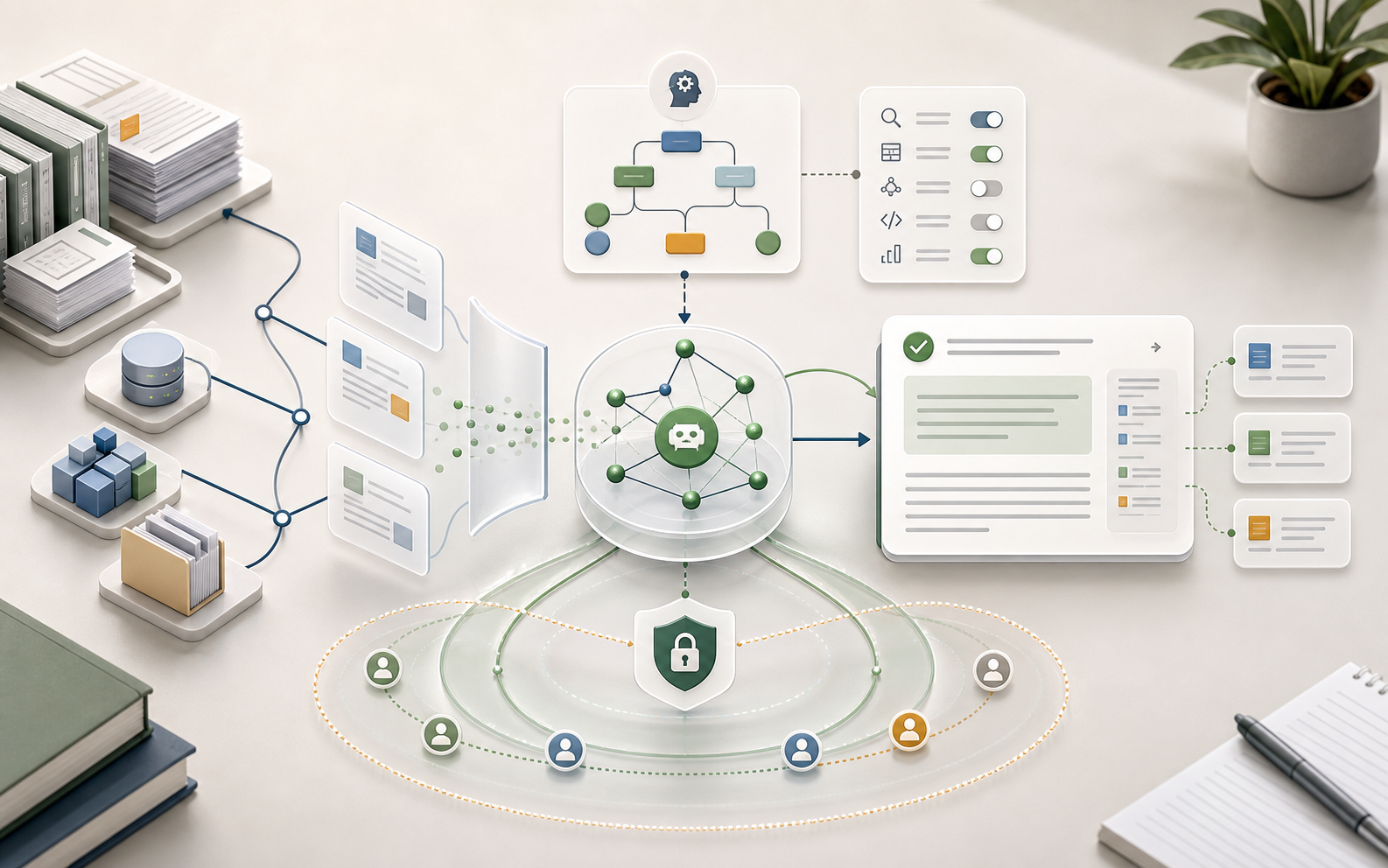
From RAG to Agentic RAG
RAG, or retrieval-augmented generation, is a pattern where an AI system retrieves relevant documents or records before generating an answer. It is useful when answers should be grounded in company materials instead of model memory alone.
Agentic RAG adds an agent layer. The system does not only retrieve once and answer. It can decide what to search, break a question into sub-questions, call tools, compare sources, ask for clarification, and stop when the evidence is insufficient.
For internal knowledge search, this difference matters. Business questions often require several steps: identify the right policy, check the latest contract, compare past proposals, and explain which source supports the answer.
Design around real internal questions
A practical Agentic RAG project should start from repeated questions, not from the document repository itself. Good starting points include sales proposal search, support policy lookup, onboarding knowledge, internal approval rules, and technical operation manuals.
For each question type, define the acceptable sources, the required answer format, the person who owns the source, and the cases where the system should refuse to answer.
This keeps the system from becoming a broad chat interface that sounds useful but cannot be trusted for decisions.
Permission and citation design
Internal search must preserve business permissions. If a user cannot access a record in the source system, an AI layer should not expose it through a summary.
Citations are also part of the product, not a decoration. Users need to see which document, section, record, or timestamp supports the answer, especially when the answer affects customers, pricing, contracts, security, or compliance.
Agentic RAG should log retrieved sources, tool calls, answer versions, and human review points. These logs make it possible to improve retrieval quality and investigate disputed answers.
A practical implementation sequence
Start with one high-frequency workflow and a small set of approved sources. Build retrieval quality first, then add agentic planning only where single-step retrieval is not enough.
Next, test the system with real questions from operators. Track whether answers are grounded, whether citations are useful, whether the system refuses appropriately, and whether people actually return to it.
Agentic RAG is most valuable when it is treated as a managed knowledge workflow. It needs source ownership, permission design, evaluation data, and a process for updating documents.
References and sources
The RAG framing refers to the original retrieval-augmented generation research and adapts it to practical internal knowledge search design.